Mixing the powder. You need to understand exactly what type of powder mixer you need. I see that you have a 5% corn syrup supplement. Syrup, as I understand it, in liquid form. This creates a big problem with high-quality mixing with dry powder, and later with its packing into bags.
About granulation. By themselves, dry powder particles do not form into granules. The powder should be moistened with a liquid with a binder added to it. It can be powdered sugar, an aqueous solution of gelatin and a bunch of other substances that ensures the gluing of particles together.
That is, you need to take a powder and some liquid with a bonding agent. Then you need to gradually inject this liquid into the powder through the sprayer, while stirring. Then the moistened mass needs to be granulated.
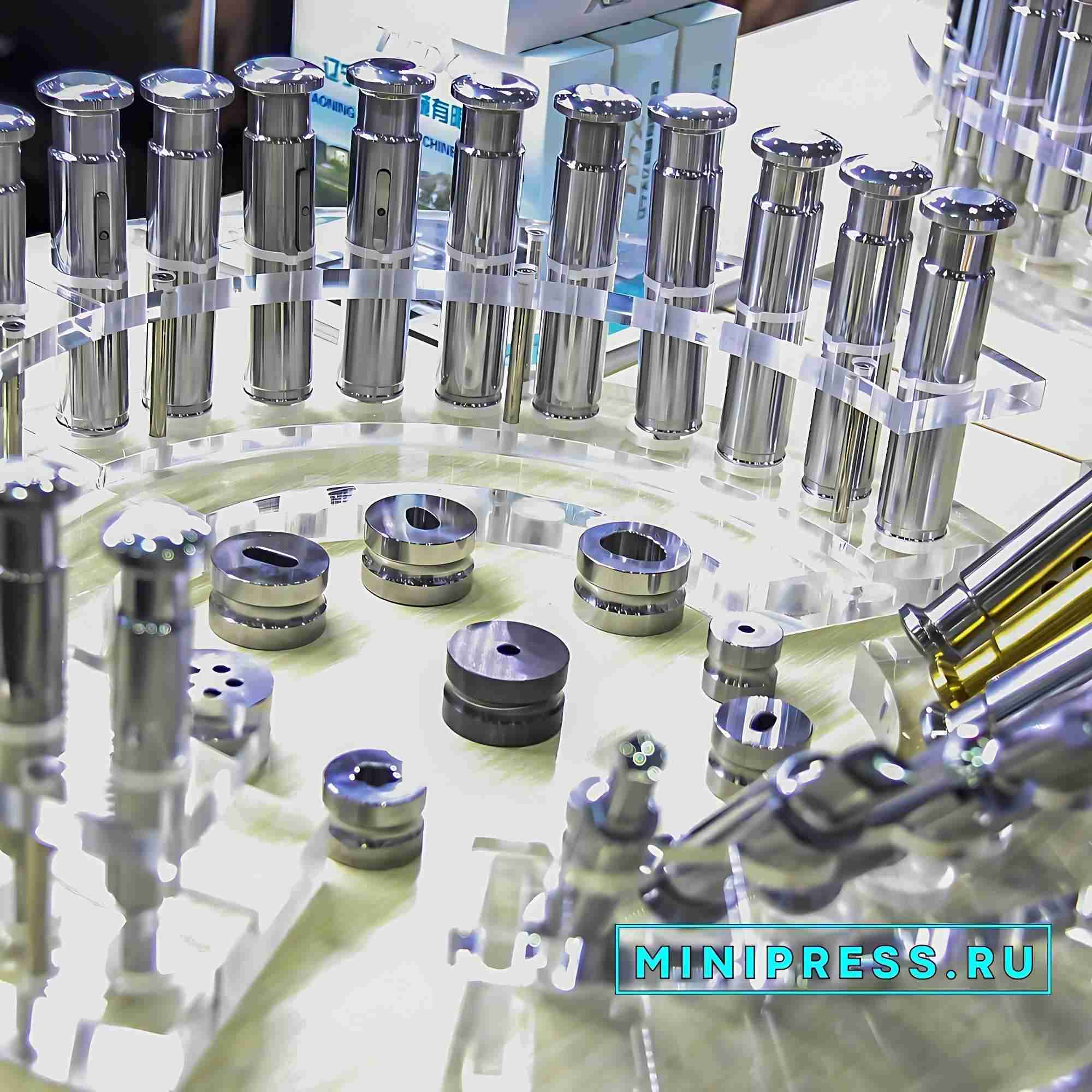
First, even if you do not take into account the fact that there will be a hole inside your tablet, but simply consider pressing a tablet with a diameter of 2.2 - 4.5 mm, then the question of feeding powder into such a hole becomes acute. This is possible only with some exceptional flowability of the powder, or forcibly. The powder will not go by gravity into such a hole. Now the same task, but you need to feed the powder evenly around the stem, which forms the inner hole. This is a difficult task, let's say.
You are going to press dishwasher tablets or for washing machines. And, as it happens, you encounter this for the first time. Pressing of such tablets is a simple process, but there are all sorts of points about which I must warn you.
Moment 1. The composition of such powders, which are pressed into tablets, includes a lot of surfactants (surfactants). Which are the detergent components. Such surfactants, when in the air, absorb moisture, which leads to the active adhesion of the powder to the walls of the punches. You need to be mentally prepared for the fact that there may be difficulties and you will need to change, select the composition of your powder mixture. It is far from easy and not easy.
Usually you need to link each car to the others in the line.
1. You need to wash the vials and dry them before filling. How do you plan for this to work?? Wash and dry small batches of bottles of the same type on the day of work, or for a week or a month?
2. Next, you need to submit empty bottles to the place of filling. Do you have several product positions, do you want to pour everything on one machine, or will each type of product have its own machine? 1200 bottles per hour, in principle, can be filled with a desktop typewriter. That's just the question - how to seal it and transfer the filled vials to the capping so that they do not turn over.
Here are my tips for you. Now the most important thing about the ability of the granulator to make pellets of the quality you need. In fact, a granulator is a simple mechanical device that wipes moistened powder through holes in a mesh or stainless steel sheet. Granulator - Does not mix powder - Does not moisten powder - Does not mix moistened powder - Does not dry granules - Does not divide granules into good and nonconditioning. - Does not give 100% granules of the same shape size, etc. Its simple function is to wipe the powder you moistened through the holes. To check whether the granulator is suitable for you, you can easily and simply (and at the same time practice in humidification technology) Pour 1 kg of powder into the basin, moisten it (the question is what exactly ???!!! ) to such an extent that the powder in your fist, when it is squeezed, leaves an imprint in your hand (well, in general, it does not crumble). Strong hydration will not form granules, weak too. With strong humidification, there will be a problem with drying.
The first thing you need is a storage table, from which empty cans will go to the filling line. The second is the filling line. It consists of 16 dispensers located on the same line in a row.Each dispenser supplies a specific color of paint. On the conveyor, empty bottles in the amount of 16 pieces fall under the spouts of dispensers. The remaining bottles are restrained by automatic locking locks. It will be possible to adjust the supply of any number of bottles from 1 to 16 pieces.
Each dispenser supplies a specific color of paint. On the conveyor, empty bottles in the amount of 16 pieces fall under the spouts of dispensers. The remaining bottles are restrained by automatic locking locks. It will be possible to adjust the supply of any number of bottles from 1 to 16 pieces.
1. The critical part. The text was logical only to the point where the required productivity of 150,000 pieces per month is indicated. You will probably be surprised, but if you take 25 working days, then it's only 6000 pieces per day. And if we assume an 8-hour working day, then you only need to pour 750 bottles per hour. What lines of automatic lines are you talking about??? The more or less automatic line is from 2000 vials per hour. You won't have anything to download it with. And pay a lot of money to turn on the line for 8 hours a month. With your volumes, one grandmother will be enough, who will use semi-automatic desktop machines especially slowly. By the way, the idea of making bottles yourself is also quite controversial (not logical). And of course we have all these desktop machines in stock.
Choose the press model that suits you in terms of price and performance. That's enough to get started. You will have a press, you already have powder. Start the pressing process.
As problems arise, we will solve them with my help. Any press can make 10-20 tablets.
The term "coated coating" comes from the French word "dragee" and means "applying a sugar coating".
A drained tablet consists of a core tablet containing a medicinal substance (substance) and a coating containing several excipients. The core tablet must be mechanically strong. Tablets to be drained should not have a flat shape to avoid sticking together.
Let's consider one of the old methods of coating — sugar coating. Sugar coating is an effective way of applying large layers of coatings, primarily to mask the taste. This type of coating is used for temperature-sensitive and brittle solid dosage forms.
The first stage of this technology is the spraying of a solution for spraying onto a particle (tablet, pellet). The air supplied to the device evaporates the liquid and dries the sugar layer. With intermittent supply of the solution, the particles remain in the process until the desired layer thickness is reached. The coating of particles is carried out evenly over the surface, while the mass of the layer varies from 0.5 to 2 mm. Currently, a large number of tablets are being drained, including: tablets of some hormonal medicine; some choleretic agents; synthetic preparations (gl...

 Deutsch
 Français
 Italiano
 Polski
 Español
 Русский
 Português


 8809
 8528580